|
|
CeBit with BindKraft
Starts: 03/20/2017 14:23
Ends: 03/24/2017 14:23
Posted on: 03/17/2017 14:58
Posted by: root - Michael Palazov - Elfial
 We are going to be on CeBIT this year, showing mostly the BindKraft SPP (Single Page Platform). Unfortunately we are in the beginning of the process of making it open source, but we have something to show and a lot more work done that needs mostly documenting and organizing. BindKraft was "born in battle" as means to do our work for various clients faster, planning easier and avoid most of the dependencies on too many external libraries (modern WEB software often goes way too far with this). Its roots go up to 10 years ago and what we are doing now is cleaning, documenting and generally preparing to present this as a set of tools and libraries available not only for us, but for anybody interested. The technology is already mature, but we never had the time to present it by itself before - separate from specific projects, now we are doing exactly that. You can learn a thing or two on the BindKraft.io web site, we are constantly adding information, examples and even new features, so what you can see there is only the beginning, if you find it intriguing, come back often or just contact us. I hope we will be ready to officially go open source in the early summer, this will be announced on the WEB site. 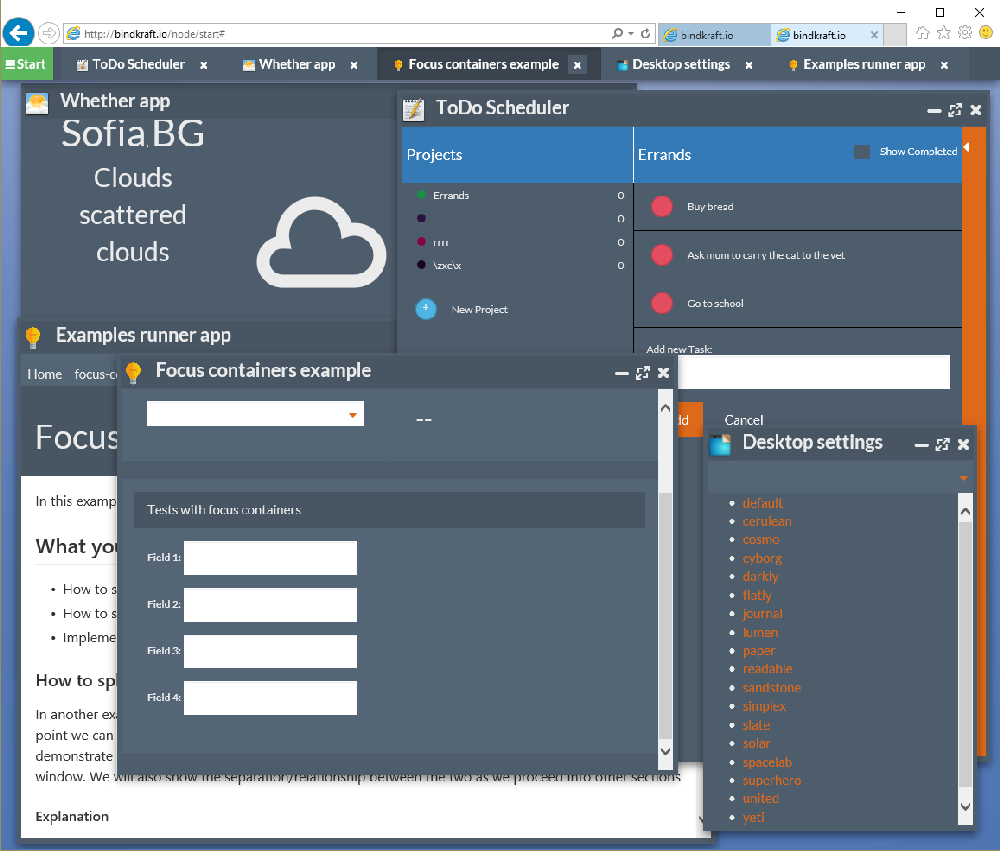
Screenshot 2BindKraft in a few sentences:It is a set of platforms both on client and the server. They can be used separately and together for drastically increased effect. The client side is an extensive Javascript OOP based platform that includes everything from data-binding, windowing, managed communications, abstract communications, DOM level and control/widget based design opportunities (can be mixed), application management etc. It all forms the basis on which one can offer end-to-end WEB based platform of applications and tools in a desktop and/or mobile manner. In a single page multiple related and unrelated BindKraft applications work at the same time, providing desktop-like experience (or mobile one, or responsive, morphing UI and functionality). Big projects do not need to be done as single integrated applications, they can be split into apps and added gradually, they can interact with each other or function in independent manner - whichever fits the needs of the moment. The Javascript framework offers in pattern agnostic way basis for many kinds of solutions, integration and so on. Perhaps the most important effect for the business is that it is natural to add functionality and apps gradually without breaking the existing ones. No matter if you follow an Agile development process or not, you got this effect whether you wanted or not - it is just a natural consequence of the architecture and the way OOP is involved in it. 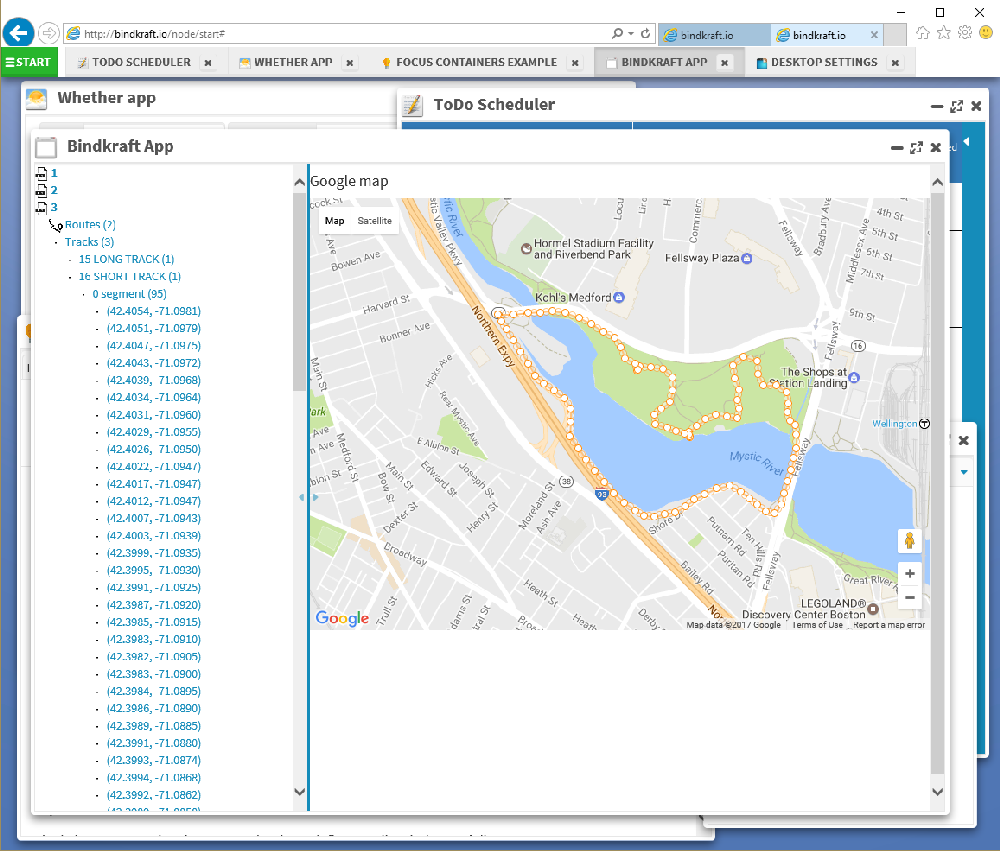
Screenshot 3BindKraft does not shy from allowing the server side and client side cooperate or to be built for each other when it comes to the main server backing the platform. In this respect you can assume that from a simplistic point of view the main server is in a way like the file system for a regular desktop application, while the other WEB services (from other servers) are the network. This makes possible to minimize to almost zero the efforts and code needed for trivial stuff and concentrate on the rest. So, there is also a server side of the BindKraft, based on shared (between the client and server) data state tracking and fetching/storing not only records, but entire trees of data in a single operations. Also the server side BindKraft concept (the main server, this does not apply to services consumed from outside, of course) includes the idea of OOB (Out of band data) and packaging work data with cachable resources to minimize the number of requests. Thus with BindKraft in action you can see HTML templates, translations, lookups and other resources fetched in a single request together with some data requested for a particular operation. We also introduced batches of such operations lately, which brings this even further - to a point where you can streamline writing operations in a single burst - much like desktop applications would allow you to edit complex data/document and save it when finished. This may be not so important for big or small projects, but it opens the opportunity to use light-weight database engines on the server in middle sized projects that include a lot of data entry for example.
Event location
Hanover, Germany
Attached images
Screenshot 4 (look at a template source)
|
